Cardullo Robert James the Pianist the Hudson Review
| Lost in Translation | |
|---|---|
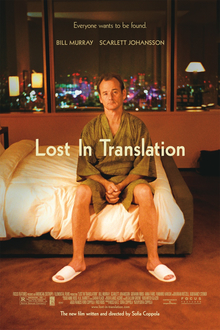 Theatrical release poster | |
| Directed by | Sofia Coppola |
| Written by | Sofia Coppola |
| Produced by |
|
| Starring |
|
| Cinematography | Lance Acord |
| Edited by | Sarah Flack |
| Music by |
|
| Product |
|
| Distributed by |
|
| Release dates |
|
| Running fourth dimension | 102 minutes[2] |
| Countries |
|
| Language | English[2] |
| Budget | $4 meg |
| Box office | $118.seven million |
Lost in Translation is a 2003 romantic comedy-drama film[annotation 1] written and directed past Sofia Coppola. Beak Murray stars as Bob Harris, a fading American movie star who is having a midlife crisis when he travels to Tokyo to promote Suntory whisky. At that place, he befriends some other estranged American named Charlotte, a young woman and recent college graduate played by Scarlett Johansson. Giovanni Ribisi and Anna Faris likewise characteristic. The film explores themes of alienation and disconnection confronting a backdrop of cultural deportation in Japan. Further analysis by critics and scholars has focused on the film'due south defiance of mainstream narrative conventions and its singular depiction of romance.
Coppola started writing the film later on spending time in Tokyo and becoming addicted of the city. She began forming a story about two characters experiencing a "romantic melancholy"[4] in the Park Hyatt Tokyo, where she stayed while promoting her first feature picture show, the 1999 drama The Virgin Suicides. Coppola envisioned Murray playing the role of Bob Harris from the beginning and tried to recruit him for up to a year, relentlessly sending him telephone messages and letters. While Murray somewhen agreed to play the part, he did not sign a contract; Coppola spent a quarter of the film's $iv meg budget without knowing if he would appear in Tokyo for shooting. When Murray finally arrived, Coppola described feelings of significant relief.
Principal photography began on September 29, 2002, and lasted 27 days. Coppola kept a flexible schedule during filming with a pocket-size crew and minimal equipment. The screenplay was short and Coppola oft allowed a meaning amount of improvisation during filming. The film's director of photography, Lance Acord, used bachelor light as ofttimes as possible and many Japanese places of business and public areas were used as locations for shooting. After 10 weeks of editing, Coppola sold distribution rights for the Usa and Canada to Focus Features, and the visitor promoted the film past generating positive word of oral cavity earlier its theatrical release.
The film premiered on Baronial 29, 2003, at the Telluride Picture show Festival and was a major critical and commercial success. Critics praised the performances of Murray and Johansson, too as the writing and direction of Coppola; express criticism was given to the film's delineation of Nippon. At the 76th Academy Awards, Lost in Translation won Coppola Best Original Screenplay, and the film was also nominated for Best Picture, All-time Director (Coppola), and Best Player (Murray). Other accolades won include three Gilded World Awards and three British Academy Film Awards.
Plot [edit]
Bob Harris is a fading American movie star who arrives in Tokyo to appear in lucrative advertisements for Suntory whisky. He stays at the upscale Park Hyatt Tokyo and is suffering from strains in his 25-yr union and a midlife crisis. Charlotte, another American staying at the hotel, is a immature Yale Academy graduate who is accompanying her husband John while he works as a celebrity photographer in Japan. Charlotte is feeling similarly disoriented as she questions her contempo spousal relationship and is unsure about her future. They both grapple with additional feelings of jet lag and civilization shock in Tokyo and often pass the time lounging around the hotel.
Charlotte is repelled by a vacuous Hollywood extra named Kelly, who is besides at the Park Hyatt, promoting an action film. She bumps into Charlotte and John, gushing over photography sessions she has previously done with him. Bob and Charlotte often happen across each other in the hotel and eventually innovate themselves in the hotel bar.
After several encounters, when John is on assignment outside Tokyo, Charlotte invites Bob into the metropolis to see some local friends. They bond through a fun night in Tokyo, where they experience the city nightlife together. In the days that follow, Bob and Charlotte spend more than time together, and their friendship strengthens. One night, while neither can slumber, the two share an intimate chat most Charlotte's personal uncertainties and their married lives.
Bob spends the nighttime with a jazz singer from the hotel bar on the penultimate night of his stay. Charlotte hears the woman singing in Bob's room the next morning, leading to tension betwixt Bob and Charlotte during luncheon together afterwards that day. The pair reencounter each other in the evening when Bob reveals that he will be leaving Tokyo the following day.
Bob and Charlotte reconcile and limited how they will miss each other, making a final visit to the hotel bar. The side by side morning, when Bob is leaving the hotel, he and Charlotte share sincere just unsatisfactory goodbyes. On Bob'southward taxi ride to the drome, he sees Charlotte on a crowded street, stops the car, and walks to her. He and then embraces her and whispers something in her ear. The two share a kiss, say farewell, and Bob departs.
Bandage [edit]
- Bill Murray every bit Bob Harris, a fading movie star
- Scarlett Johansson as Charlotte, a contempo college graduate
- Giovanni Ribisi every bit John, Charlotte'due south married man, a glory photographer
- Anna Faris every bit Kelly, a Hollywood actress
- Fumihiro Hayashi as Charlie, Charlotte'south friend
- Catherine Lambert equally a jazz vocalist[note 2]
Analysis [edit]
Themes [edit]
He was trapped.... When yous get to a foreign state, truly strange, there is a major shock of consciousness that comes on you when you run across that, "Oh God, information technology's just me hither." There'south nobody, no neighbors, no friends, no phone calls—just room service.
—Beak Murray, speaking about Bob Harris[half-dozen]
The film's author-director, Sofia Coppola, has described Lost in Translation as a story about "things existence disconnected and looking for moments of connexion",[7] a perspective that has been shared by critics and scholars. In a cultural sense, Bob and Charlotte are disoriented by feelings of jet lag and civilisation shock as a result of strange travel to Japan. Bob is bewildered past his interactions with a Japanese commercial director whom he cannot understand, realizing that the significant of his communication is "lost in translation" by an interpreter.[8] [notation 3] Moreover, both are sleepless from a alter in time zone, choosing to cope with their wakefulness by making late-night visits to the hotel bar. Such feelings provoke a sense of estrangement from their environment, merely they also exacerbate deeper experiences of alienation and disconnection in their lives.[10] Bob and Charlotte are both in troubled marriages and facing similar crises of identity; Charlotte is unsure of what to exercise with her life and questions what role she should encompass in the world, while Bob is invariably reminded of his fading stature as a movie star and feels disassociated from the identity by which he is already defined.[11]
Such experiences are heightened by the characters' contact with the metropolis environs of Tokyo; Bob feels alienated by seeing his likeness used in an advertisement while he is driven from the airport to his hotel, and the colorful cityscape is rendered as a corybantic environment past which he is overwhelmed.[12] [note 4] Charlotte feels adrift equally she attempts to find meaning while wandering Tokyo,[13] and she feels isolated every bit she peers over the city from her hotel room window.[14] The Park Hyatt Tokyo offers hermetic qualities that insulate the characters from the urban center and is the site Bob chooses to seek refuge from his ails.[15] These shared impressions of breach create common ground for Bob and Charlotte to cultivate a personal connection.[ten] When Charlotte invites Bob to experience the Tokyo nightlife, she reduces his sense of altitude from the city[10] and the two develop a connexion based on small-scale moments together. In the little time they have together, each realize they are not lone in seeking a sense of something deeper in their lives.[16] Coppola, speaking most the cursory nature of their encounter, remarked, "For everyone, in that location are those moments when you take great days with someone you lot wouldn't await to. Then you have to become back to your existent lives, just it makes an impression on you. It's what makes it and then slap-up and enjoyable."[17]
Geoff King, a scholar who wrote a book about the pic, comments that the experiences of the key characters are one gene that lends Lost in Translation to varied interpretations past academics.[eighteen] Todd McGowan reads the picture show from a Lacanian psychoanalytic perspective, arguing that the motion picture encourages the embrace of "absence" in one'south life and relationships.[19] He describes Coppola's depiction of Tokyo "as a city bubbling over with excess", which offers an empty promise of gratification.[20] In his view, both Bob and Charlotte recognize that they cannot find meaning in Tokyo's attractions, so they bond over their shared sense of emptiness in them.[20] Lucy Bolton offers a feminist reading, arguing that Lost in Translation evokes the thought of feminist philosopher Luce Irigaray past highlighting issues of young womanhood. She argues that the movie provides a circuitous portrait of Charlotte's female person subjectivity and an optimistic rendering of the character'southward pursuit for individual expression.[21]
Narrative [edit]
Lost in Translation has been broadly examined in terms of its narrative structure, with commentators noting that it contains few plot events as compared with films in the Hollywood mainstream. Narrative events are more often than not focused on the evolution of Bob and Charlotte'south human relationship,[22] with few "external" obstacles that bear upon the central characters.[23] King notes, "More time is taken to evoke the impressions, feelings, and experiences of the cardinal characters",[24] which represents "a shift in the hierarchical system of [pic elements]" that prioritizes graphic symbol experiences over plot.[25] The literary critic Steve Vineberg argues that "the links of the story are indeed in that location, but they're not typical cause-and-effect connections. They're formed by the emotions that gather at the end of 1 episode and pour into the side by side".[26] King maintains that while the plot does progress according to a basic linear causality,[22] "If the episodic quality often seems to the fore, this is partly a matter of the pacing of individual sequences that are very oft leisurely and dedicated to the institution or evolution of mood and altercation".[24] Coppola said she wanted the story to emphasize the qualities of an intimate moment, and she did non want to impose grandiose narrative devices on the characters such as "a war keeping them apart".[27] [note five]

Coppola said of the motion picture's opening shot, "I don't accept a really good reason for it.... It'southward merely how I wanted to outset the movie. I liked having a hint of the character—a sweet, immature girl waiting around in her hotel room—and then go into the story".[29] [annotation 6]
The picture's opening shot has been another point of word amongst critics and scholars. The 36-second shot, which features Charlotte's backside every bit she lies on a bed wearing transparent pinkish panties, is based on the photorealist paintings of John Kacere[32] and has oftentimes been compared to the initial appearance of Brigitte Bardot in the 1963 moving picture Contempt.[notation 7] While some have described it equally a foreshadowing of a romance between Bob and Charlotte,[annotation 8] the film historian Wendy Haslem argues that "Coppola'southward intention with this opening shot appears to be to defy taboos and to undermine expectations surrounding what might be considered the 'coin shot' in more traditionally exploitative movie house."[ten] Correspondingly, the bookish Maria San Filippo maintains that "[Coppola] doesn't seem to be making a statement at all beyond a sort of endorsement of beauty for dazzler's sake."[33] Male monarch notes that the image contains both "subtle" and "obvious" appeal in its combination of artful and erotic qualities, which signifies Lost in Translation 's position between mainstream and contained film.[34] The motion-picture show scholar Todd Kennedy interprets information technology in terms of feminist moving-picture show theorist Laura Mulvey'south conception of the male gaze, arguing that the shot "lasts so long every bit to become awkward—forcing the audience to get aware of (and potentially even question) their participation in the gaze."[35]
Lost in Translation has besides been noted for defying the conventions of mainstream romantic films. Haslem writes that the archetype romantic comedy assures the audience that the couple has a hereafter, merely Coppola defies expectations by refusing to unite the central characters.[10] She points to elements such equally Bob and Charlotte's lack of sexual consummation as i gene that obscures whether their pairing is more romantic or platonic. Writing most the concluding sequence in which the characters make their final goodbyes, Haslem argues, "Conventionally in mainstream cinema, the kiss... signifies resolution by reinforcing the myth of romantic love. Merely in this new moving ridge of contemporary anti-romance romance, the kiss signifies ambiguity."[ten] The academic Nicholas Y.B. Wong contends that the film's lack of "heart-melting connections and melodramatic (re)unions between characters" represents a postmodern portrait of love, writing that Lost in Translation is "about non-honey, the predominance of affairs and the complexities of intimacy. Characters vacillate between falling in love and out of love. They are neither committed to someone nor emotionally unattached."[12] Coppola said Bob and Charlotte's human relationship is "supposed to be romantic only on the edge.... [A] fiddling flake more than friends only not an actual romance.... To me, it'south pretty united nations-sexual between them—innocent and romantic, and a friendship."[36]
Production [edit]
Writing [edit]

After dropping out of college in her early twenties,[37] Coppola oft traveled to Tokyo, trying out a variety of jobs in fashion and photography.[38] Unsure of what to do for a career, she described this period equally a "kind of crisis"[37] in which she meandered effectually the city contemplating her future.[29] She came to feel fond of Tokyo, noting an otherworldly quality brought on as a foreigner grappling with feelings of jet lag in an unfamiliar setting.[39] After many years, she settled on a career in filmmaking and returned to the city, staying at the Park Hyatt Tokyo to promote her outset feature motion-picture show, the 1999 drama The Virgin Suicides.[17] [note ix]
Coppola began writing Lost in Translation after returning dwelling from this press tour.[7] Having been influenced past her background in Tokyo, she resolved to write a screenplay prepare there[17] [note 10] and began forming a story almost two characters experiencing a "romantic melancholy" in the Park Hyatt Tokyo.[four] Coppola was long attracted to the neon signs of the metropolis and envisaged Tokyo taking on a "dreamy feeling" in the flick.[38] She recruited her friend Brian Reitzell, who ultimately served every bit the film's music producer, to create dream pop compilation mixes that she listened to while writing to assist establish this mood.[41]
Coppola did not initially write the screenplay in traditional script form, citing the difficulty of mapping out a full plot.[iv] Instead, she opted to write "piddling paragraphs" largely based on disparate impressions and experiences of her life in Tokyo, which she then adapted to a script.[iv] Among the first images she included was of her friend Fumihiro Hayashi performing a karaoke rendition of the Sex Pistols' "God Save the Queen", which Coppola saw him perform during the time she worked in Tokyo.[29] After writing the starting time 20 pages with assistance from her brother, Roman Coppola, she returned to Tokyo for further inspiration.[seven] There, she videotaped anything she could utilize as a further writing aid.[36]
Coppola envisioned Murray playing the role of Bob from the beginning, wanting to show off "his more sensitive side"[36] and feeling tickled by the image of him dressed in a kimono.[17] She described her mental pictures of Murray as a pregnant source of inspiration for the story.[5] For the character of Charlotte, Coppola drew from her own feelings of early-twenties disorientation, citing the strain in her relationship with her then-husband Spike Jonze as an influence for the relationship between Charlotte and John.[42] She also drew inspiration from J. D. Salinger's character Franny in Franny and Zooey, finding appeal in "the thought of a preppy daughter having a breakup".[37]
As she developed the human relationship between Bob and Charlotte, Coppola was compelled by the juxtaposition of the characters having similar internal crises at different stages of their lives.[43] She cited the dynamic betwixt Humphrey Bogart and Lauren Bacall in The Big Sleep equally a source of inspiration for their relationship.[7] Coppola reported doing little re-writing of the script,[16] which took six months to complete[7] and culminated in 75 pages, much shorter than the average feature moving picture script.[44] [note 11] Despite worrying that the screenplay was too short and "indulgent" for including assortments of her personal experiences, she resolved to begin production of the film.[37]
Development [edit]


Coppola maintained that she would not have made Lost in Translation without Murray.[32] The histrion had an 800 number for prospective clients interested in casting him, only he had a reputation as a recluse who was difficult to contact.[46] Coppola relentlessly pursued him and sent phone messages and letters for months.[43] She likewise sought people in her professional network that might help her brand contact.[31] She recruited screenwriter Mitch Glazer, who was a longtime friend of Murray'southward, to accept an early version of the script and attempt to persuade him.[42] Glazer was impressed with the story and said he called the actor frequently, telling him, "Y'all need to read this",[46] just he would non provide an answer.[42] After up to a year of cajoling, Murray finally agreed to meet with Coppola at a restaurant to discuss the flick.[42] He then accepted the part, saying "she spent a lot of time getting me to be the guy. In the cease, I felt I couldn't let her down."[31]
Despite Murray's understanding, Coppola had to take him at his word, as he did not sign a formal contract.[seven] She described this as "nerve-wracking", wondering if he would evidence up for filming in Tokyo.[7] She discussed the upshot with director Wes Anderson, who had previously worked with the histrion and encouraged her, saying, "If he says he'southward going to practice it, he'll prove up."[vii] For Murray's co-star, Coppola liked Johansson's operation in Manny & Lo, remembering her "equally a cute piddling daughter with that husky voice".[17] She then invited Johansson to a eating house to discuss the office.[xxx] Initially worried that the 17-year-one-time Johansson might be as well young to play a grapheme in her twenties, the managing director concluded that she appeared older and could convincingly play the part.[47] Coppola offered Johansson the role without an audition, which she accepted.[30]
Feeling a sense of personal investment in the project, Coppola wanted to maintain last cut privilege and feared that a distribution deal with a North American studio would threaten her influence.[vii] It was too unlikely that a studio would provide such bankroll, given the short length of the screenplay and Murray's lack of formal involvement.[48] Instead, she and her agent opted to sell foreign distribution rights to an assortment of companies to fund production costs of $4 one thousand thousand.[7] She struck a deal outset with Japan's Tohokushinsha Picture, so with distributors in France and Italy, and finally with the international arm of Focus Features for the remaining foreign market.[vii] Past piecing together the funding from multiple distributors, Coppola reduced the influence of whatsoever single financier.[48] Still not knowing if Murray would show upward in Tokyo, Coppola spent $1 million of the budget,[7] knowing that his absence would doom the product. When he finally arrived, days before filming, she described feelings of meaning relief.[49]
Filming [edit]

The production used bystanders as extras in public areas such as Shibuya Crossing.
Chief photography began on September 29, 2002, and lasted 27 days.[17] With a tight schedule and a limited $4 million budget, filming was done six days per week and was marked by a "run-and-gun" arroyo: Coppola was keen to stay mobile with a small crew and minimal equipment.[36] She conducted few rehearsals and kept a flexible schedule, sometimes scrapping filming plans to shoot something she noticed on location if she thought it better served the story.[9] [note 12] Since the screenplay was sparse, missing details were often addressed during shooting, and Coppola allowed a significant corporeality of improvisation in dialogue, especially from Murray.[sixteen] One instance includes the scene in which Bob is being photographed for Suntory whisky; Coppola encouraged Murray to react to the lensman spontaneously as she whispered names for the homo to repeat to Murray as unrehearsed dialogue, such as "Roger Moore".[16] [five] [note 13]
While key crew members were Americans that Coppola invited to Tokyo, most of the crew was hired locally.[9] This proved to exist challenging for the production, as virtually of the Japanese coiffure could not communicate with Coppola in English, and then both sides relied on translations from a bilingual assistant director and a gaffer.[36] The production encountered frequent delays while translations took place and suffered from occasional cultural misunderstandings; in ane instance, Coppola described a shoot in a eating place that ran 10–15 minutes late, something she said was normal on an American shoot,[17] but information technology prompted the eating house owner to feel disrespected; he afterwards disconnected the crew'south lights and the picture show's Japanese location manager resigned.[7] Despite this, Coppola said she worked to adapt to a Japanese style of filmmaking, non wanting to impose an approach that her crew was not used to.[36]
Coppola worked closely to visualize the movie with her director of photography, Lance Acord. She showed him and other fundamental coiffure members a volume of photographs she created that represented the visual way she wanted to convey in the pic.[xvi] To evoke a sense of isolation in Bob, Coppola and Acord used stationary shots in the hotel and avoided conspicuous camera movements.[51] They also had numerous discussions well-nigh shooting on video, but they ultimately decided that moving-picture show amend suited the romantic undertones of the story.[36] Coppola remarked, "Flick gives a trivial bit of a altitude, which feels more similar a retentiveness to me. Video is more than present tense".[36] Acord believed that new motion picture stocks would reduce the demand for excessive lighting, ultimately using Kodak Vision 500T 5263 35 mm stock for night exteriors and Kodak Vision 320T 5277 stock in daylight.[52] Well-nigh of the film was shot on an Aaton 35-III while a smaller Moviecam Compact was used in confined locations.[52]
With high-speed pic stocks, Acord chose to utilise bachelor light equally oft as possible,[53] only supplementing with artificial lights when necessary.[52] He reported "never really" rigging lights for night exteriors, relying on the natural low-cal on Tokyo'due south city streets.[52] For interior sequences in the Park Hyatt Tokyo, he relied by and large on the hotel'southward practical lighting sources, shooting at a wide open f-end and heavily cut the light to eliminate reflections in the hotel window.[54] Acord said he heard objections about lighting from some of the Japanese electricians, who were unaccustomed to relying and then much on available light and were concerned that the exposure would not be sufficient.[55] Acord, assured that the film stocks would concord up against lower lighting, ultimately shot much of the film two stops underexposed.[53]
Many of the shooting locations were Japanese places of business and public areas at the time of filming, including New York Bar in the Park Hyatt Tokyo and Shibuya Crossing in Tokyo. On public streets and subways, the production did not secure filming permits[32] and relied on city bystanders every bit extras;[36] Coppola described the shooting as "documentary-manner"[17] and was worried at times most getting stopped past police force, and so she kept a minimal crew.[36] In the hotel, the product was not allowed to shoot in public areas until i or 2 a.m. to avoid disturbing guests.[56] In the film'south concluding sequence in which Bob and Charlotte make their final goodbyes, Coppola reported beingness unhappy with the dialogue she had scripted, so Murray improvised the whisper in Johansson's ear.[sixteen] Besides quiet to be understandable, Coppola considered dubbing audio in the scene, but she ultimately decided information technology was better that information technology "stays between the ii of them".[16] After production ended, Coppola supervised 10 weeks of editing by Sarah Flack in New York Metropolis.[28]
Soundtrack [edit]
The film's soundtrack was released past Emperor Norton Records on September ix, 2003.[57] It contains 15 tracks, largely from the shoegaze and dream pop genres of indie and alternative rock. The soundtrack was supervised by Brian Reitzell and contains songs from artists and groups including Death in Vegas, Phoenix, Squarepusher, Sébastien Tellier, and Happy End. The Jesus and Mary Concatenation's song "Merely Like Honey" and "Sometimes" past My Encarmine Valentine featured, and four original tracks were written for Lost in Translation by the latter band's frontman, Kevin Shields.[58] Other tracks produced for the film include two co-written by Reitzell and Roger Joseph Manning Jr., and one by Air.[58] Songs featured in the film that are not in the soundtrack include karaoke performances of Elvis Costello's cover of "(What'southward So Funny 'Bout) Peace, Love, and Understanding" and The Pretenders' "Brass in Pocket". A further performance past Murray of Roxy Music'south "More than This" is included as a bonus track.[annotation 14]
During the screenwriting stage, Coppola spoke to Reitzell almost the "moody" and "melancholic" qualities she wanted the music to convey in the flick, too equally what Reitzell understood to be the "strange, floating, jet-lagged weirdness" that would define the primal characters.[41] Coppola said she wanted the soundtrack "to be less like a score" and more like the dream-popular mixes Reitzell made to assist her writing of the film.[17] While Shields had released piffling music since the release of Loveless in 1991,[59] at Reitzell's suggestion, he and Coppola enlisted him to aid write original music for the film;[60] Reitzell believed Shields "could capture that droning, swaying, beautiful kind of feeling that nosotros wanted."[41] He then joined Shields in London for some 2 months[61] of overnight recording sessions, and they used the screenplay and dailies from product as inspiration while they worked on songs for the film.[41] Shields commented on the challenge he felt in songwriting for a flick, maxim "I was barely aware of the linguistic communication of music that's not substantially just for your ears. ... In the end, merely the physical movement of the film, that was a effeminateness. And I suppose that'south why I ended upward doing stuff that was and so delicate."[58]
King argues that music often plays the nearly significant part in setting mood and tone in the movie, writing that information technology is substantial "in evoking the dreamy, narcotised, semi-detached impressions of jet-lag" as well equally broader feelings of alienation and disconnection, "making what is probably the largest single contribution to the widespread agreement of the film as a 'mood piece'."[62] He points to the use of "Girls" by Expiry in Vegas, featured in the early sequence in which Bob is driven from the airdrome to the hotel, arguing that it "plays a role equal to if non dominating that of the visuals..., creating a globe-trotting, ethereal and somewhat dreamy quality that precisely captures the impressions of temporal and spatial disjunction".[63] He also points to the employ of "absurd and distant" tracks like "Tommib", used in the extended sequence featuring Charlotte observing Tokyo while seated in her hotel room window, as playing a significant role in establishing feelings of isolation and disorientation in the character.[64] In Male monarch's view, some sequences characteristic combinations of music and visuals so as to function equally "audio-visual set pieces", which offer distinct points of entreatment in the film for its target audience.[65]
Release [edit]
Marketing [edit]
Coppola did not sell distribution rights for the United States and Canada until she and Flack finished editing the pic.[44] In February 2003, the manager showed the moving picture to top executives at the domestic arm of Focus Features,[44] the company to which it had already sold well-nigh of the foreign distribution. The prior contract proved to be significant for Focus, as it received privileged access to the moving picture while competing buyers complained that they were restricted to the viewing of a 3-infinitesimal trailer in the Focus offices at the American Flick Market.[66] Coppola initially offered the domestic distribution rights for $5 million, but she decided to sell them to Focus for $4 one thousand thousand, citing her appreciation for the international deals the company had secured for the moving picture.[44]
One time Focus was involved, it began promoting the film by employing a conventional "indie-mode" marketing entrada.[67] The strategy involved generating positive discussion of mouth for the film well before its September 2003 release.[68] The benefactor arranged advance press screenings throughout the summer of 2003 and combined this with a magazine publicity campaign.[68] [note 15] Posters and trailers emphasized the recognizable star presence of Murray, highlighting his performance in the film's comic sequences, which favored wider audition appeal.[69] Immediately prior to its release, Focus placed Lost in Translation in film festivals and hosted "intimate media screenings" that included question-and-answer panels with Coppola and Murray.[44] Many of these marketing tacks were designed to promote the film at minimal toll, a departure from more costly strategies ofttimes employed in the Hollywood mainstream, such as major telly advertising.[67]
Theatrical run [edit]
Lost in Translation had its premiere on August 29, 2003, at the Telluride Film Festival in the U.s.a..[3] Two days later, it appeared at the Venice Flick Festival in Italy, and on September 5, 2003, it was shown at the Toronto International Moving picture Festival in Canada.[3] Information technology opened to the public in express release on September 12, 2003, at 23 theaters in major cities in the United states of america, including New York City, Los Angeles, and San Francisco.[70] The film had already generated speculation about Oscar contention from accelerate screenings and was noted for opening several weeks before than expected for an indie vying for awards—a gamble being that opening too early might crusade the film to be forgotten by the time nominations were made for major prizes like the Academy Awards.[68] [71] Focus Features co-presidents James Schamus and David Linde commented that the company chose an early on release date on the basis of factors including the motion-picture show's quality and early on marketing entrada, equally well as a lack of contest from other films.[68] The strategy was intended to give Lost in Translation more time to command the marketplace.[72]

Graph showing the estimated number of theaters in which Lost in Translation played in the United States, Canada, and Puerto Rico in 2003–2004.[73] Focus Features expanded its theater presence in January afterward information technology received nominations for the 76th Academy Awards.
The motion-picture show grossed $925,000 in its opening weekend and was expanded the next week from 23 theaters to 183[68] in the height 25 markets of the country.[lxx] There, it grossed more than than $ii.62 million over the weekend[74] and almost paid off the total budget of the pic. Information technology entered broad release on Oct 3,[note 16] its fourth weekend, peaking at a rank of seven in the box office chart;[73] a week afterwards, it expanded to an estimated 882 theaters, the picture'due south highest theater count over its run.[73] Lost in Translation grossed an estimated to-appointment total of $xviii.5 million through October 13[73] and was noted by The Hollywood Reporter to have been performing well even "in smaller and medium-sized markets where audiences don't ever reply to this blazon of upscale textile".[68] Following this performance, Lost in Translation saw a gradual decline in theater presence progressing into the new year,[73] though it was expanded again after the picture show received nominations for the 76th Academy Awards.[75] The film was widened from a belatedly December low of 117 theaters to an estimated 632 at the finish of January, ultimately catastrophe its run in the United States and Canada on March 25 and earning $44.vi million.[73] Its international release earned $74.one meg, for a worldwide total of $118.seven million.[73]
Home media [edit]
The DVD of Lost in Translation was released on February three, 2004,[76] and includes deleted scenes, a backside-the-scenes featurette, a conversation about the pic featuring Murray and Coppola, and a music video for "Urban center Girl",[77] one of the original songs equanimous for the pic by Kevin Shields. Wanting to capitalize on the publicity surrounding Lost in Translation 's presence at the Academy Awards, Focus Features fabricated the unusual move of releasing the picture show on home media while information technology was all the same screening in theaters, immediately after its Oscar nominations were appear.[75] The strategy was seen every bit risky, every bit the manufacture was generally concerned that theatrical revenues could exist harmed past early home video release.[75] Lost in Translation ultimately earned nearly $5 1000000 from its first 5 days of video rentals and sold i million retail copies during its starting time calendar week of release.[78] Early returns showed it was the second-best selling DVD during this menstruation[78] while the motion-picture show screened in 600 theaters and box office revenues dropped 19% from the previous calendar week, which Variety described as "relatively modest".[79] Focus credited the performance to positive word of mouth and cited the marketing for the pic on both media as helpful for whichever platform consumers chose.[79] Lost in Translation was later released on the now-obsolete HD DVD format on May 29, 2007,[80] and on Blu-ray on December 7, 2010.[81]
Reception [edit]
Critical response [edit]
Lost in Translation received widespread critical acclamation, particularly for Murray's operation and for Coppola's direction and screenplay.[82] On Rotten Tomatoes, the film has an approval rating of 95% based on 232 reviews, with an boilerplate rating of 8.4/x.[83] The site'south disquisitional consensus reads, "Effectively balancing humor and subtle pathos, Sofia Coppola crafts a moving, melancholy story that serves every bit a showcase for both Beak Murray and Scarlett Johansson."[83] On Metacritic, which assigns a normalized rating to reviews, the motion-picture show has an average score of 89 out of 100 based on 44 reviews, indicating "universal acclamation".[84]
Critics widely praised Murray's functioning as Bob, commending his handling of a more than serious office that was combined with the comic persona for which he was already broadly known. Writing for Slate, David Edelstein argued that it was "the Bill Murray performance we've been waiting for", calculation that "his two halves have never come together as they do here, in a way that connects that hilarious detachment with the deep and abiding sense of isolation that must have spawned it".[85] Lisa Schwarzbaum of Amusement Weekly regarded Murray's performance as Oscar-worthy and lauded it equally his "most vulnerable and unmannered" to date; she praised his treatment of a more delicate role besides as his improvisations in the moving-picture show'southward comic sequences.[86] The New York Times critic Elvis Mitchell had similar praise, calling Lost in Translation "Mr. Murray's pic" and remarking that the actor "supplies the kind of performance that seems and then fully realized and effortless that it can hands be mistaken for non acting at all".[87] [annotation 17]
Coppola received a similar level of acclaim for her screenplay and management. Kenneth Turan of the Los Angeles Times commented that Lost in Translation was "tart and sweet, unmistakably funny and exceptionally well observed—[which] marks... Coppola as a mature talent with a distinctive sensibility and the means to express it".[88] Much of the praise was directed specifically at her attention to qualities of subtlety and atmosphere; David Rooney of Variety praised the flick as "a mood piece", adding that its "deft remainder of humor and poignancy makes it both a pleasurable and melancholy experience".[89] Likewise, Salon critic Stephanie Zacharek lauded Coppola as a "stealth dramatist" whose understated narrative style fabricated for an aesthetic delineation of emotion; she praised Lost in Translation as an intimate story that marks Coppola equally an exceptional filmmaker.[ninety]
Praise was also offered for Johansson'south functioning as Charlotte; Rooney commented that she "gives a smartly restrained operation as an observant, questioning woman with a rich interior life",[89] and Turan added that Johansson "makes what could have been an overly familiar characterization come up completely alive".[88] Lost in Translation was listed every bit a best film of the twelvemonth by more 235 critics[91] and has appeared on other "best of" lists in the years after its release. Paste ranked it number 7 on its list of "The 50 Best Movies of the 2000s",[92] Entertainment Weekly ranked it number nine on its listing of the decade's top ten,[93] and the picture show was ranked number 22 on a 2016 listing of the BBC's 100 Greatest Films of the 21st Century, based on a poll of 177 critics.[94]
Allegations of racism [edit]
While not a topic of nigh reviews, Lost in Translation received some charges of Orientalist racial stereotyping in its depiction of Japan.[95] The filmmaker E. Koohan Paik argued that the moving picture's comedy "is rooted entirely in the 'otherness' of the Japanese people", and that the story fails to offer balanced characterizations of the Japanese, calculation that "it is... the shirking of responsibleness to describe them as full human beings, either negative or positive, which constitutes discrimination, or racism".[96] Similarly, the artist Kiku Twenty-four hours charged in The Guardian that "[t]here is no scene where the Japanese are afforded a shred of dignity. The viewer is sledgehammered into laughing at these small, xanthous people and their funny ways".[97] Prior to the film's release in Nippon, local distributors were reported to have business organisation about how information technology would be received in that location,[98] and the moving-picture show was ultimately met with criticism in some Japanese reviews; amongst them, critic Yoshiro Tsuchiya of Yomiuri Shimbun wrote that Coppola's representation of Japan was "outrageously biased and banal".[99] Perceptions of stereotyping likewise led to a campaign against the motion-picture show by an Asian American organization that urged members of the Academy of Motion Picture Arts and Sciences to vote against it at the 76th Academy Awards.[100]
The film scholar Homay Male monarch argues that while the pic ultimately does lilliputian to counter Orientalist stereotypes, it fails to constitute the perspective from which Japanese representations are made, writing that "the picture show [does not] sufficiently clarify that its existent subject is not Tokyo itself, but Western perceptions of Tokyo.... When Nippon appears superficial, inappropriately erotic, or unintelligible, we are never completely sure whether this vision belongs to Coppola, to her characters, or simply to a Hollywood cinematic imaginary".[101] Moreover, Geoff King maintains that while depictions such as Charlotte's alienation from experiences like ikebana are evidence that the motion picture abstains from the Orientalist "mythology of Japanese tradition as source of solace", the film frequently situates Nippon as a source of "deviation" for the characters by relying on crude jokes and stereotypes of the Japanese every bit "crazy" or "farthermost".[102] Coppola reported being surprised past such criticism, saying, "I think if everything'due south based on truth y'all can make fun, have a little express mirth, but as well be respectful of a culture. I but love Tokyo and I'm not mean-spirited".[39]
Accolades [edit]
Lost in Translation received awards and nominations in a variety of categories, particularly for Coppola'southward direction and screenwriting, as well every bit the performances of Murray and Johansson. At the 76th Academy Awards, it won Best Original Screenplay (Coppola) and the movie received three further nominations for Best Movie, Best Director (Coppola), and All-time Actor (Murray).[103] The movie garnered iii Aureate Globe Awards from five nominations: All-time Motion picture – Musical or Comedy, Best Actor – Motion Picture Musical or One-act, and Best Screenplay.[104] At the 57th British Academy Film Awards, Lost in Translation won 3 awards: Best Actor in a Leading Role, Best Actress in a Leading Part (Johansson), and Best Editing.[105]
Lost in Translation likewise received awards from various foreign award ceremonies, film festivals, and critics' organizations. These include Best American Film at the Bodil Awards,[106] Best Foreign Film at the César Awards,[107] and All-time Foreign Film at the Moving-picture show Critics Circle of Commonwealth of australia,[108] French Syndicate of Picture palace Critics,[109] and Deutscher Filmpreis,[110] as well as the Nastro d'Argento for Best Strange Director.[111] The film also won the Contained Spirit Accolade for Best Film,[112] All-time Picture – Comedy or Musical at the Satellite Awards,[113] and two prizes at the Venice International Motion-picture show Festival.[114] [3] From critics' organizations, Lost in Translation received awards in the Best Film category from the San Francisco Picture show Critics Circle,[115] the Toronto Film Critics Association,[116] and the Vancouver Film Critics Circle.[117]
References [edit]
Annotations [edit]
- ^ The movie has been noted for its resistance to any atypical genre classification. While it has been labeled in terms such as "romantic comedy", the motion picture has been identified for integrating elements from multiple genres, including romance, comedy, and drama. For one discussion of Lost in Translation 'south position between genres, meet Male monarch 2010, pp. 60–75.
- ^ Lambert was an bodily performer in the bar at the Park Hyatt Tokyo. Coppola saw her sing "Scarborough Fair" at the hotel a twelvemonth earlier filming and afterwards induced a manager to assist identify her so Coppola could bandage her. Lambert performed the same song in the film.[5]
- ^ This scene is an homage to a Suntory commercial Coppola's father, Francis Ford Coppola, shot with Akira Kurosawa in the 1970s.[9] Coppola said that like Bob, Murray did non understand what the man playing the manager was proverb. She remarked that "I similar the fact that the American actors don't really know what's going on, only like the characters."[eight]
- ^ Some commentators have described Tokyo itself as a third major character in the flick. For examples, meet San Filippo 2003, p. 28, and Plate 2004, para. 4.
- ^ Coppola has best-selling her appreciation for "meandering mood pieces"[16] and cited influences for Lost in Translation from films such as L'Avventura, La Dolce Vita,[v] and In the Mood for Dear.[28] La Dolce Vita is briefly featured past Coppola in a scene in which Bob and Charlotte are watching the moving picture on television while drinking sake.
- ^ Johansson was initially humble about wearing sheer panties for the shot, but she conceded later Coppola showed her what they looked like by modelling them personally.[thirty] Johansson said she would not have worn them if the film's director was a man.[31]
- ^ For examples, see Kennedy 2010, pp. 46–47, San Filippo 2003, p. 26, and Haslem 2004.
- ^ For example, run across Smith, Paul Julian (2004). "Tokyo Drifters". Sight & Sound. Vol. xiv, no. one. p. 13.
- ^ Coppola has spoken favorably about her personal experiences staying at the hotel. She has described the locale as a "silent floating isle" within the "chaotic" city environment of Tokyo,[36] and she has named information technology one of her "favorite places in the globe".[17]
- ^ Later its release, Coppola called Lost in Translation a "valentine" to Tokyo[40] and cited a desire to portray what she liked about the metropolis as 1 reason for making the film.[36]
- ^ A feature motion picture script is typically 90–120 pages.[45]
- ^ One example includes the sequence featuring Charlotte walking through Shibuya Crossing. When Coppola noticed that rain had made the area look hazy and atmospheric, she scrapped filming plans in a nearby arcade to shoot the sequence.[seven]
- ^ Other examples of significant improvisation during shooting include the scenes that occur in the karaoke box[7] and sushi eating place.[17]
- ^ "(What'south So Funny 'Bout) Peace, Love, and Understanding" was called for Bob to highlight his position in an older generation, "Brass in Pocket" was chosen for Charlotte to evidence her playful side, and "More Than This" was chosen extemporaneously by Coppola and Murray during shooting, later the two discovered they had a common affinity for Roxy Music.[xvi]
- ^ For ane example of a magazine article cited by Focus as being part of this campaign, see Hirschberg 2003.[68]
- ^ "Broad release" is defined hither as crossing the 600-theater threshold.
- ^ In the bonus features of the motion picture'due south 2004 DVD, Murray chosen Lost in Translation his favorite film that he has appeared in.
Footnotes [edit]
- ^ "Interpreter's notes". The Japan Times. April 14, 2004. Archived from the original on January eight, 2019. Retrieved Baronial eight, 2020.
- ^ a b "Lost in Translation". British Lath of Pic Classification. Retrieved May 15, 2020. Notation: Select the "Details" and "Feature" tabs.
- ^ a b c d e "Lost in Translation (2003)". American Film Institute. Archived from the original on July 5, 2020. Retrieved June 8, 2020.
- ^ a b c d Olsen, Marker (Jan 2004). "Sofia Coppola: Cool and the gang". Sight & Sound. Vol. xiv, no. i. p. 15.
- ^ a b c d Allen, Greg (August 31, 2003). "Mafia Princess: An Interview with Sofia Coppola". Greg.org. Archived from the original on Oct 12, 2003. Retrieved May 3, 2020.
- ^ Murray, Rebecca. "Interview with Bill Murray". Most. Archived from the original on October 24, 2005. Retrieved June i, 2020.
- ^ a b c d due east f g h i j yard l m n o Thompson, Anne (Fall 2003). "Tokyo Story". Filmmaker. Archived from the original on June 11, 2020. Retrieved May 3, 2020.
- ^ a b Rich, Motoko (September 21, 2003). "What Else Was Lost In Translation". The New York Times. Archived from the original on March iv, 2020. Retrieved June 1, 2020.
- ^ a b c Grove, Martin A. (August fifteen, 2003). "Give-and-take is terrific for Coppola'southward 'Translation'". The Hollywood Reporter.
- ^ a b c d eastward f Haslem, Wendy (April 2004). "Neon Gothic: Lost in Translation". Senses of Cinema (31). Archived from the original on September xi, 2019. Retrieved June 1, 2020.
- ^ Rogers 2018, p. 73.
- ^ a b Wong 2009, p. 133.
- ^ Plate 2004, para. 3.
- ^ King 2010, p. 104.
- ^ Cardullo 2004, p. 464.
- ^ a b c d e f g h i Chumo, Peter N. II (Jan–February 2004). "Honoring the Little Moments: Lost in Translation". Creative Screenwriting. Vol. 11, no. 1. Archived from the original on October 13, 2016. Retrieved May seven, 2020.
- ^ a b c d e f g h i j k Mitchell, Wendy (Feb 4, 2004). "Sofia Coppola Talks About 'Lost In Translation,' Her Love Story That's Not 'Nerdy'". IndieWire. Archived from the original on Baronial 13, 2019. Retrieved May three, 2020.
- ^ King 2010, p. 127.
- ^ McGowan 2007, p. 62.
- ^ a b McGowan 2007, p. 54.
- ^ Bolton 2011, pp. 126–127.
- ^ a b King 2010, p. 76.
- ^ King 2010, p. 82.
- ^ a b King 2010, p. 80.
- ^ King 2010, pp. 81–82.
- ^ Vineberg, Steve (October 17, 2003). "Jet lag". The Christian Century. Vol. 120, no. 21. p. 60. Retrieved June 1, 2020.
- ^ Interview 2003, p. 56.
- ^ a b Crabtree, Sheigh (September x, 2003). "Editor Flack in Fashion for Coppola's 'Lost' Motion picture". The Hollywood Reporter.
- ^ a b c Diaconescu, Sorina (September 7, 2003). "An upstart, casual but confident". Los Angeles Times . Retrieved May 3, 2020.
- ^ a b c Vernon, Polly (December 28, 2003). "Scarlett fever". The Guardian. Archived from the original on July eleven, 2019. Retrieved May 3, 2020.
- ^ a b c Hirschberg, Lynn (August 31, 2003). "The Coppola Smart Mob". The New York Times Magazine. Archived from the original on July 22, 2017. Retrieved May 3, 2020.
- ^ a b c Stern, Marlow (September 12, 2013). "Sofia Coppola Discusses 'Lost in Translation' on Its 10th Ceremony". The Daily Beast. Archived from the original on January 14, 2020. Retrieved May 7, 2020.
- ^ San Filippo 2003, p. 26.
- ^ Male monarch 2010, pp. ane–2.
- ^ Kennedy 2010, p. 45.
- ^ a b c d due east f yard h i j grand l "Lost In Translation". Focus Features. Archived from the original on October 1, 2003. Retrieved May 3, 2020.
- ^ a b c d Meyer, Carla (September 20, 2003). "Sofia Coppola has a little humor and, now, a big film. Father Francis and husband Spike? Not a factor. / Managing director-writer's sophomore effort translates into growing respect". San Francisco Chronicle. Archived from the original on March ten, 2016. Retrieved May 3, 2020.
- ^ a b Topel, Fred (September 23, 2003). "Sofia Coppola on 'Lost in Translation'". Screenwriter'south Monthly . Retrieved May 3, 2020.
- ^ a b Morrow, Fiona (Jan 2, 2004). "Sofia Coppola: Hollywood princess". The Independent . Retrieved May 3, 2020.
- ^ Calhoun, Dave (Fall–Wintertime 2003). "Watching Bill Murray Movies". Another Magazine (5): 100.
- ^ a b c d Hundley, Jessica (September 11, 2003). "An invisible part". Los Angeles Times . Retrieved May 3, 2020.
- ^ a b c d Peretz, Evgenia (September 2006). "Something About Sofia". Vanity Fair . Retrieved May 3, 2020.
- ^ a b Betts, Kate (September 8, 2003). "Sofia's Choice". Time . Retrieved May 3, 2020.
- ^ a b c d eastward Harris, Dana (October 12, 2003). "New moving-picture show legends of the fall". Diversity. Archived from the original on Apr 3, 2019. Retrieved May 3, 2020.
- ^ Hilliard, Robert L. (Baronial 10, 2011). Writing for Telly, Radio, and New Media (tenth ed.). Cengage Learning. p. 403. ISBN978-1439082713.
- ^ a b Brownfield, Paul (February 29, 2004). "What about Nib?". Los Angeles Times . Retrieved May 3, 2020.
- ^ Clark, John (November 9, 2003). "Young middle and old soul". Los Angeles Times . Retrieved May three, 2020.
- ^ a b King 2010, p. 8.
- ^ "Our Own Private Hollywood". Elle. October 7, 2010. Retrieved May iii, 2020.
- ^ Acord 2004a, p. 22.
- ^ a b c d Acord 2004a, p. 21.
- ^ a b Acord, Lance (January 2004b). "Channeling Tokyo for 'Lost in Translation'". American Cinematographer. Vol. 85, no. ane. pp. 123–124.
- ^ Acord 2004a, p. 23.
- ^ Acord 2004a, p. xix.
- ^ Acord 2004a, p. 24.
- ^ "Lost in Translation OST". Metacritic . Retrieved May 20, 2020.
- ^ a b c Dansby, Andrew (September 24, 2003). "Kevin Shields Found on 'Lost'". Rolling Stone . Retrieved May 20, 2020.
- ^ White, Michael. "My Encarmine Valentine's Kevin Shields: An Enigma Emerges". Exclaim!. Archived from the original on September 16, 2019. Retrieved May twenty, 2020.
- ^ Keast, James (October 1, 2003). "Lost In Translation: Sofia Coppola'due south Journey Into Culture Disharmonism". Exclaim!. Archived from the original on September 16, 2019. Retrieved May 20, 2020.
- ^ "From My Bloody Valentine to 'Lost in Translation'". NPR (Audio). September xv, 2003. Archived from the original on February 4, 2020. Retrieved May 20, 2020.
- ^ King 2010, p. 115.
- ^ Rex 2010, pp. 115–116.
- ^ Male monarch 2010, pp. 116–119.
- ^ King 2010, p. 117.
- ^ Harris, Dana; Dunkley, Cathy (February 25, 2003). "Focus frames 'Lost' deal at finish of AFM". Diverseness . Retrieved May 9, 2020.
- ^ a b King 2010, p. 16.
- ^ a b c d due east f chiliad Grove, Martin A. (October ten, 2003). "Focus Heads Focus on 'Translation' Success". The Hollywood Reporter.
- ^ King 2010, pp. 24–25.
- ^ a b Brooks, Brian (September 16, 2003). "The Land of the Rising Box Office Shines Bright for 'Lost in Translation'". IndieWire. Archived from the original on May 28, 2018. Retrieved May 10, 2020.
- ^ Rex 2010, pp. 16–17.
- ^ Male monarch 2010, p. 17.
- ^ a b c d due east f one thousand "Lost in Translation". Box Office Mojo . Retrieved July 4, 2020.
- ^ Brooks, Brian (September 23, 2003). "'Scarface' Lashes the B.O.; Docs Continue Strong". IndieWire . Retrieved May x, 2020.
- ^ a b c King 2010, p. 22.
- ^ "Lost in Translation Details and Credits". Metacritic. Archived from the original on August 13, 2018. Retrieved May ten, 2020.
- ^ Lost in Translation (DVD). Focus Features. Feb iii, 2004.
- ^ a b Saccone, Melinda (February 15, 2004). "Coppola's Oscar-Lauded Film Translates Well to Video". Video Store Magazine. Vol. 26, no. 7. p. 18.
- ^ a b Hettrick, Scott (Feb 17, 2004). "'Lost' translates to DVD, bigscreen". Diverseness . Retrieved May x, 2020.
- ^ "Lost in Translation Hd DVD Review". High-Def Digest. May 31, 2007. Archived from the original on December 13, 2017. Retrieved May 10, 2020.
- ^ Miller, Gordon S. (January 4, 2011). "Lost in Translation Blu-ray Review". Loftier-Def Assimilate. Archived from the original on February 18, 2017. Retrieved May 10, 2020.
- ^ King 2010, pp. 28–29.
- ^ a b "Lost in Translation (2003)". Rotten Tomatoes. Archived from the original on June 5, 2020. Retrieved July 10, 2020.
- ^ "Lost in Translation (2003)". Metacritic. Archived from the original on June 17, 2020. Retrieved May 12, 2020.
- ^ Edelstein, David (September 11, 2003). "Prisoner of Nippon". Slate . Retrieved May 12, 2020.
- ^ Schwarzbaum, Lisa (September xi, 2003). "Lost in Translation". Entertainment Weekly. Archived from the original on Dec six, 2019. Retrieved May 12, 2020.
- ^ Mitchell, Elvis (September 12, 2003). "An American in Japan, Making a Connexion". The New York Times. Archived from the original on May 23, 2013. Retrieved May 12, 2020.
- ^ a b Turan, Kenneth (September 12, 2003). "Bill at his best". Los Angeles Times. Archived from the original on April 3, 2020. Retrieved May 12, 2020.
- ^ a b Rooney, David (Baronial 31, 2003). "Lost in Translation". Variety. Archived from the original on July 14, 2018. Retrieved May 12, 2020.
- ^ Zacharek, Stephanie (September 13, 2003). "Lost in Translation". Salon. Archived from the original on July 3, 2020. Retrieved June 20, 2020.
- ^ Grove, Martin A. (January 16, 2004). "Academy Members Accept Thrown Dice or Thrown Abroad Votes". The Hollywood Reporter.
- ^ "The 50 Best Movies of the 2000s". Paste. November iii, 2009. Archived from the original on May thirteen, 2020. Retrieved May 12, 2020.
- ^ "x Best Movies of the Decade!". Entertainment Weekly. December 3, 2009. Archived from the original on June 15, 2020. Retrieved June fifteen, 2020.
- ^ "The 21st Century'due south 100 greatest films". BBC. August 19, 2016. Archived from the original on June 11, 2020. Retrieved June xv, 2020.
- ^ Rex 2010, p. 132.
- ^ Paik, East. Koohan (Nov 2003). "Is 'Lost in Translation' Racist?". ColorLines RaceWire. Archived from the original on April 18, 2005. Retrieved May 25, 2020.
- ^ Solar day, Kiku (January 23, 2004). "Totally lost in translation". The Guardian. Archived from the original on July 2, 2020. Retrieved May 25, 2020.
- ^ Rich, Motoko (January 4, 2004). "Country Of the Ascension Platitude". The New York Times. Archived from the original on October 18, 2019. Retrieved May 25, 2020.
- ^ Cited in Musetto, V.A. (May 21, 2004). "'Lost in Transition' – Japan Critics Rip Motion-picture show". New York Post. Archived from the original on October 30, 2017. Retrieved May 25, 2020.
- ^ Wright, George (February 27, 2004). "Hit film gets lost in racism row". The Guardian. Archived from the original on August 16, 2019. Retrieved May 25, 2020.
- ^ King 2005, pp. 45–46.
- ^ Male monarch 2010, pp. 130–132.
- ^ "76th Academy Awards (2004)". Academy of Film Arts and Sciences. Archived from the original on April 2, 2015. Retrieved May 10, 2020.
- ^ "The 61st Annual Gold Globe Awards". Hollywood Foreign Press Association. Archived from the original on December 20, 2016. Retrieved May ten, 2020.
- ^ "Film in 2004". British Academy of Picture show and Telly Arts (BAFTA). Archived from the original on Nov 13, 2017. Retrieved May 10, 2020.
- ^ "2005 Årets vindere" [2005 Winners of the year] (in Danish). Danish Movie Critics Association. Archived from the original on March 16, 2016. Retrieved July 4, 2020.
- ^ "Palmares: César 2005: récompenses, nominations" [Palmares: César 2005: awards, nominations]. AlloCiné (in French). Archived from the original on September 22, 2016. Retrieved May x, 2020.
- ^ "Awards Archive". Film Critics Circle of Australia. Archived from the original on March 25, 2014. Retrieved May x, 2020.
- ^ "Prix SFCC de la Critique 2004" [2004 SFCC Critics' Award] (in French). French Syndicate of Cinema Critics. Archived from the original on Apr 11, 2019. Retrieved July 4, 2020.
- ^ "Deutsche Filmpreise von 1951 Bis Heute: 2004" [German Film Awards from 1951 to Today: 2004] (in German). Deutsche Filmakademie. Archived from the original on September 23, 2015. Retrieved May 10, 2020.
- ^ "2004 (Albo d'oro)" (in Italian). Italian National Syndicate of Picture Journalists. Archived from the original on July four, 2020. Retrieved July 4, 2020.
- ^ Munoz, Lorenza (Feb 29, 2004). "'Lost in Translation' Captures Elevation Prizes at Spirit Awards". Los Angeles Times. Archived from the original on March half-dozen, 2016. Retrieved May 10, 2020.
- ^ "2004 (8th Almanac Satellite Awards)". International Press Academy. Archived from the original on December eighteen, 2008. Retrieved May 10, 2020.
- ^ "Official Awards of the 60th Mostra". Venice Biennale. September 6, 2003. Archived from the original on June 23, 2004. Retrieved July iv, 2020.
- ^ "2003 San Francisco Picture show Critics Circumvolve Awards". San Francisco Film Critics Circumvolve. December fifteen, 2003. Archived from the original on December xiv, 2014. Retrieved May 10, 2020.
- ^ "Past Award Winners". Toronto Pic Critics Association. May 29, 2014. Archived from the original on July 15, 2015. Retrieved May 10, 2020.
- ^ "fourth Annual Honor Winners". Vancouver Film Critics Circle. February 2, 2004. Archived from the original on Apr ix, 2019. Retrieved May 10, 2020.
Bibliography [edit]
- Acord, Lance (October 12, 2004a). "Lost in Translation". In Ballinger, Alex (ed.). New Cinematographers. HarperCollins. pp. xix–26. ISBN978-1856693349.
- Bolton, Lucy (July 28, 2011). Motion-picture show and Female Consciousness: Irigaray, Cinema and Thinking Women . Palgrave Macmillan. ISBN978-1137501400.
- Cardullo, Bert (Autumn 2004). "Love Story, or Coppola vs. Coppola". The Hudson Review. 57 (3): 463–470. doi:10.2307/4151446. JSTOR 4151446.
- Kennedy, Todd (Fall 2010). "Off with Hollywood's Head: Sofia Coppola as Feminine Auteur". Moving-picture show Criticism. 35 (one): 37–59.
- King, Geoff (2010). Lost in Translation. American Indies. Edinburgh University Press. ISBN978-0748637461.
- Rex, Homay (Fall 2005). "Lost in Translation" (PDF). Motion picture Quarterly. 59 (1): 45–48. doi:10.1525/fq.2005.59.1.45.
- McGowan, Todd (2007). "There is Nothing Lost in Translation". Quarterly Review of Film and Video. 24 (1): 53–63. doi:10.1080/10509200500486023. S2CID 191608894.
- Plate, Due south. Brent (April 2004). "Moving-picture show Review: Lost in Translation". Journal of Religion and Moving picture. 8 (1).
- Rogers, Anna (November 29, 2018). Sofia Coppola: The Politics of Visual Pleasure. Berghahn Books. ISBN978-1785339752.
- San Filippo, Maria (Winter 2003). "Lost in Translation". Cineaste. Vol. 29, no. ane. pp. 26–28.
- "The Co-Conspirators". Interview. Vol. 33, no. nine. October 2003. pp. 54–60.
- Wong, Nicholas Y.B. (2009). "Loving You past Not Falling in Love: The Postmodern Representation of Love in Chunking Express and Lost in Translation". Screen Education. No. 53. pp. 131–137.
External links [edit]
- Official website
- Lost in Translation at IMDb
- Lost in Translation at AllMovie
- Lost in Translation at Rotten Tomatoes
Source: https://en.wikipedia.org/wiki/Lost_in_Translation_%28film%29
0 Response to "Cardullo Robert James the Pianist the Hudson Review"
Postar um comentário